Ascent
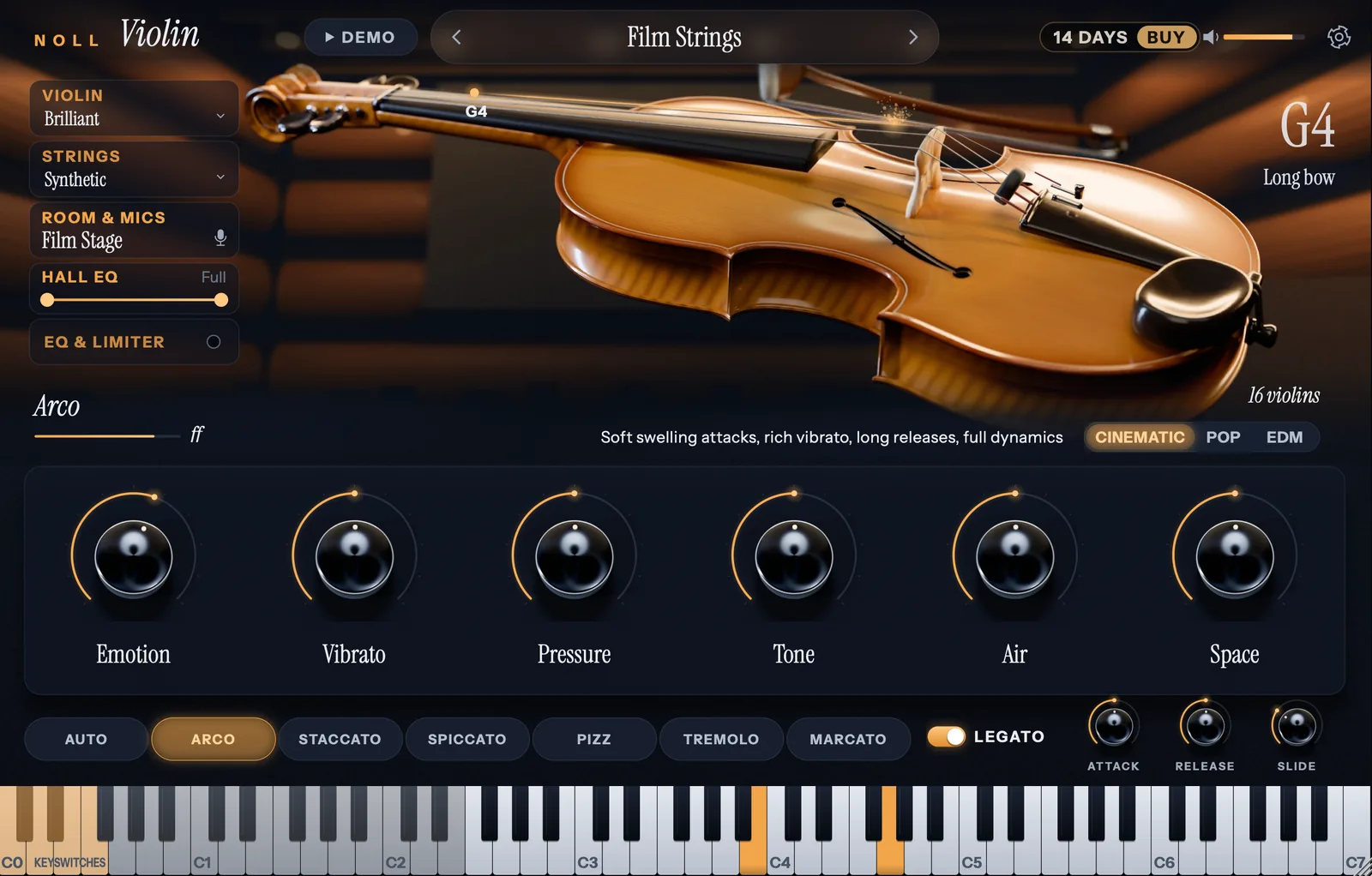
The vibrato waits, then blooms. Slides on the leaps, a legato run up to a high A, a fast run down, a bar of spiccato the Smart Player bows with no keyswitch, then sixteen violins take the line.
Six pianos.
No samples.
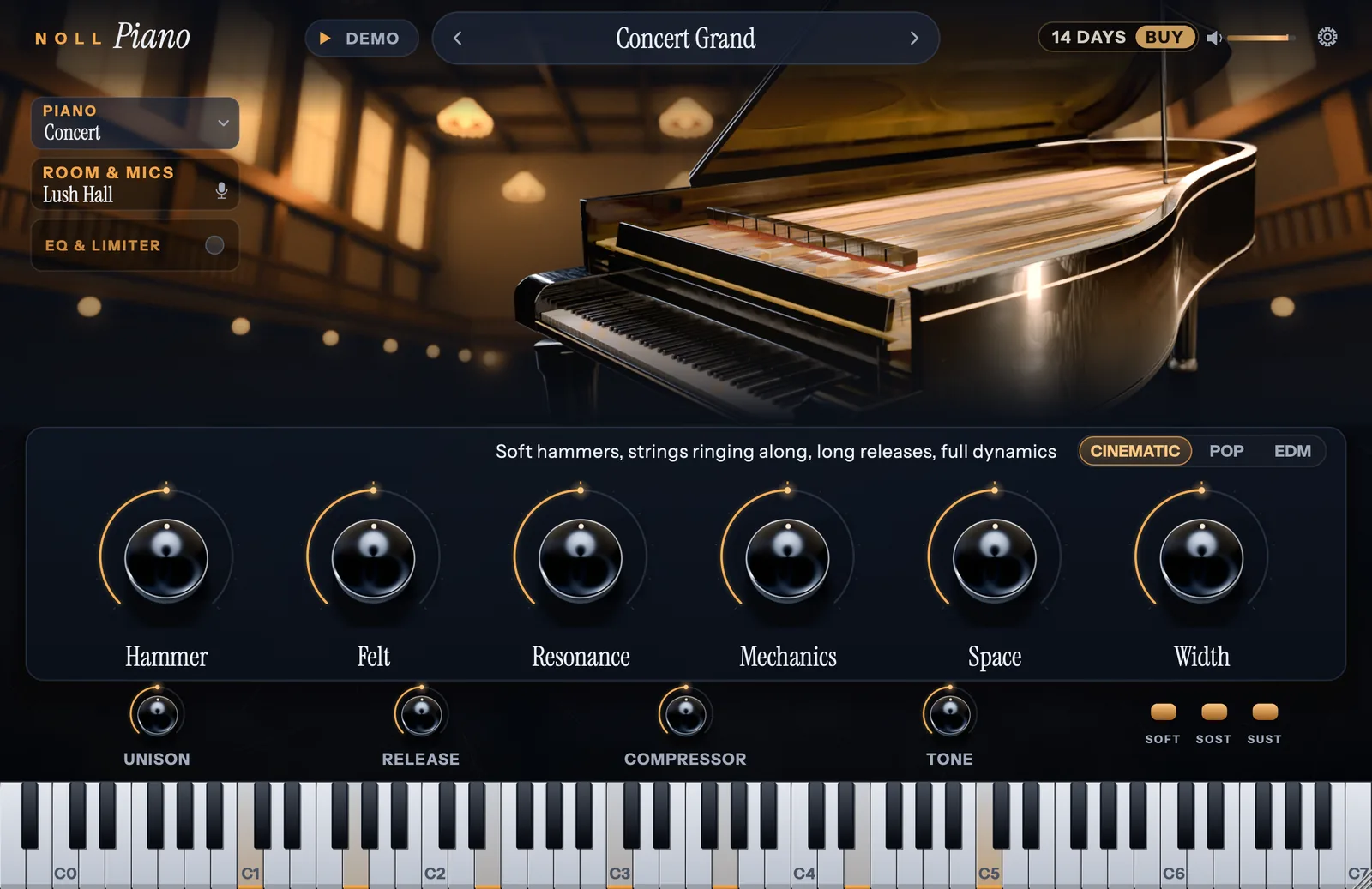
A piano built from physics: hammers, strings and a soundboard, computed as you play. Six pianos and 16 presets, light on CPU, and about 40 MB to download. It is the piano in every clip on this page.
Every clip is MIDI into the plugins, with the playing written in the way you would write it in your DAW: keyswitches or the Smart Player pick the stroke, the mod wheel (CC1) is the bow. Every sound is a NØLL plugin, the piano too. Levels and a light limiter only: no EQ, no added reverb.
The vibrato waits, then blooms. Slides on the leaps, a legato run up to a high A, a fast run down, a bar of spiccato the Smart Player bows with no keyswitch, then sixteen violins take the line.
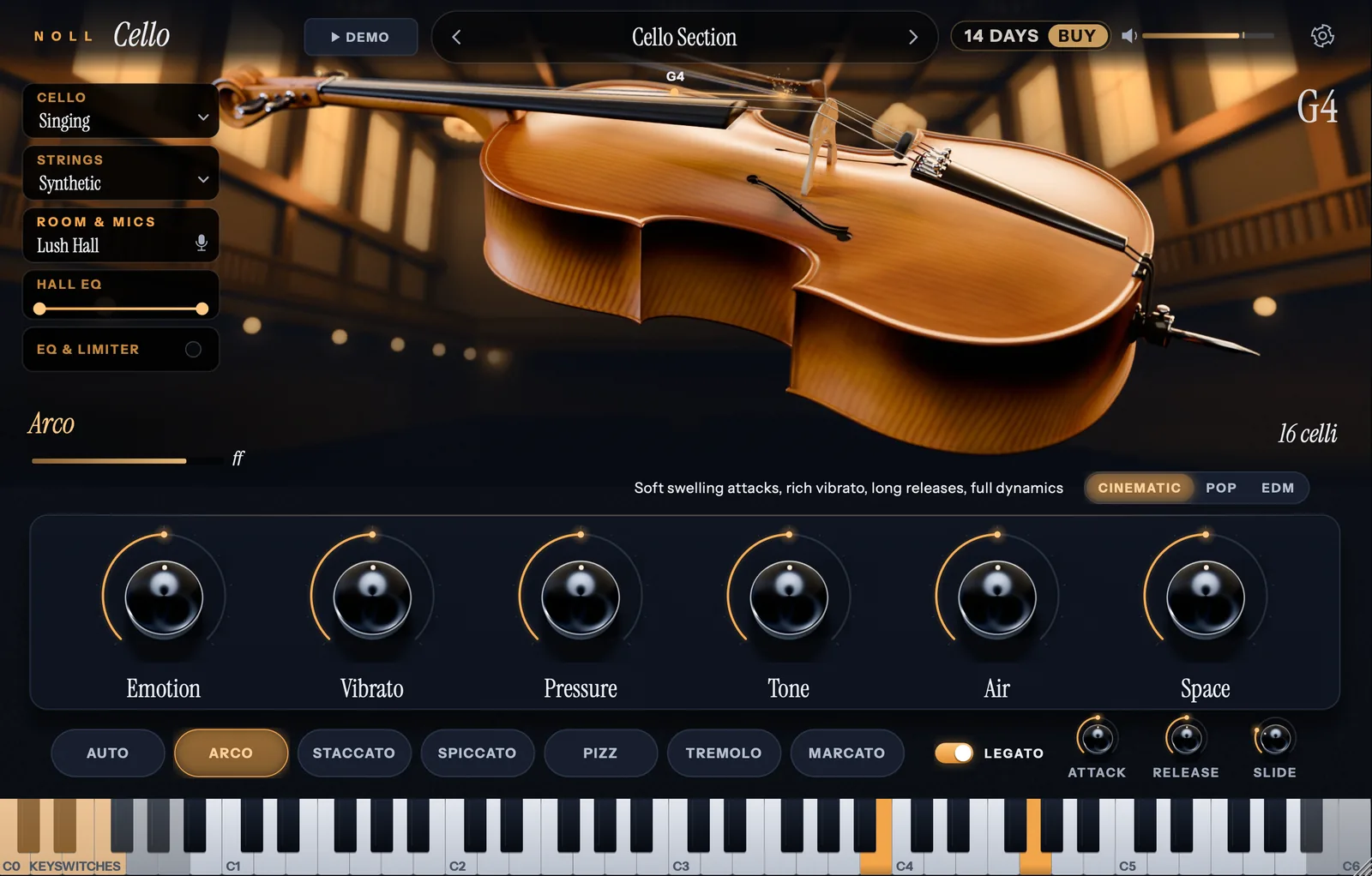
The low C string, soft on the fingerboard. A slow slide up, a singing line with the section, tremolo that walks the bow to the bridge, spiccato with accents, then pizzicato.
A singing line: a slow slide up a sixth, an octave slide, a climb to a high G, then a low E accent and a fast run. Violas, basses and piano underneath.
From a whisper at the bridge to a full roar. An ostinato the Smart Player bows on its own, pizzicato, a tremolo swell and a hit on the low C of the extension.
One theme for the whole section: violins and celli singing, violas on tremolo, basses on Auto, the piano under them. Every part is a NØLL plugin.
Overlap two notes and the player shifts to the next one, the way a violinist does. Wide leaps slide slower, steps barely slide at all, and a softly played note slides in slower still. There is no pitch bend in this clip. The swells are the mod wheel (CC1), and CC21 rides the vibrato.
The Smart Player bows each note from how you play it: how long you hold it, how close the next one is, how hard you hit it. Notes that touch go legato. Short notes bounce off the string. Accents dig in. Repeated sixteenths turn into tremolo. It does this live, in about 1.3 ms at 48 kHz, or reads up to a second ahead if you want. No keyswitches in this clip, though you can still force any stroke with one.
Every clip on this page is the plugin playing MIDI. Levels only: no EQ, no compression, no reverb added.
A slow line that climbs to a high E and settles on a three-note chord. The section splits the chord between its players on its own.
A sixteenth-note riser into a high lead, with offbeat chords under it. Two tracks of the plugin, summed.
A hook written to sit next to a vocal: close, warm and quick to speak, with slides on the leaps.
The Style switch sets what 12 o'clock means on every knob, so the middle of each knob is already a finished sound for that kind of track. The settings came from 720 test renders scored against real violinists, and each Style was then picked by ear, blind.
A physical model with a cellist inside. The Smart Player picks the stroke, the bow and the string for every note you write, for one cello or up to sixteen. Seven cello bodies, the same three Styles as the violin.
An early render of the full section. Like every clip on this page, it is the plugin playing MIDI, levels only: no EQ, no compression, no reverb added.
Violin, Viola, Cello, Double Bass and Piano, each a physical model you play from plain MIDI. NØLL Strings plays the whole section from one keyboard. All six together are the NØLL Orchestral Suite. All out Tuesday, Nov 17.
pay once · every 1.x update free for every instrument in it · mac, apple silicon and intel · vst3 and au, the five singles also standalone
Grands and uprights, a felt upright among them, each modeled from measurements of a reference instrument of its type.
Every key has its own hammer and strings, and the sound passes through a modeled soundboard.
Half-pedal works with a continuous sustain pedal. The soft pedal shifts the hammers like a real una corda.
Eleven modeled halls and a choice of microphone positions. Space sets the distance, Width the stereo spread.
Voices chords, evens out fast runs, softens fast repeats and lifts the softest notes.
Six knobs: Hammer, Felt, Resonance, Mechanics, Space and Width. 64 samples of latency (1.3 ms at 48 kHz) in every setting.
| in short | NØLL Piano |
|---|---|
| download | about 40 MB |
| inside | no samples: hammers, strings and soundboard computed as you play |
| latency | 64 samples (1.3 ms at 48 kHz), every setting |
| CPU | about 1.7 % of one core for a 10-note chord with the pedal down (Apple M4 Pro, 48 kHz, 128 samples) |
| formats | VST3, AU and a standalone app, Mac (Apple silicon and Intel) |
| price | $89, pay once |
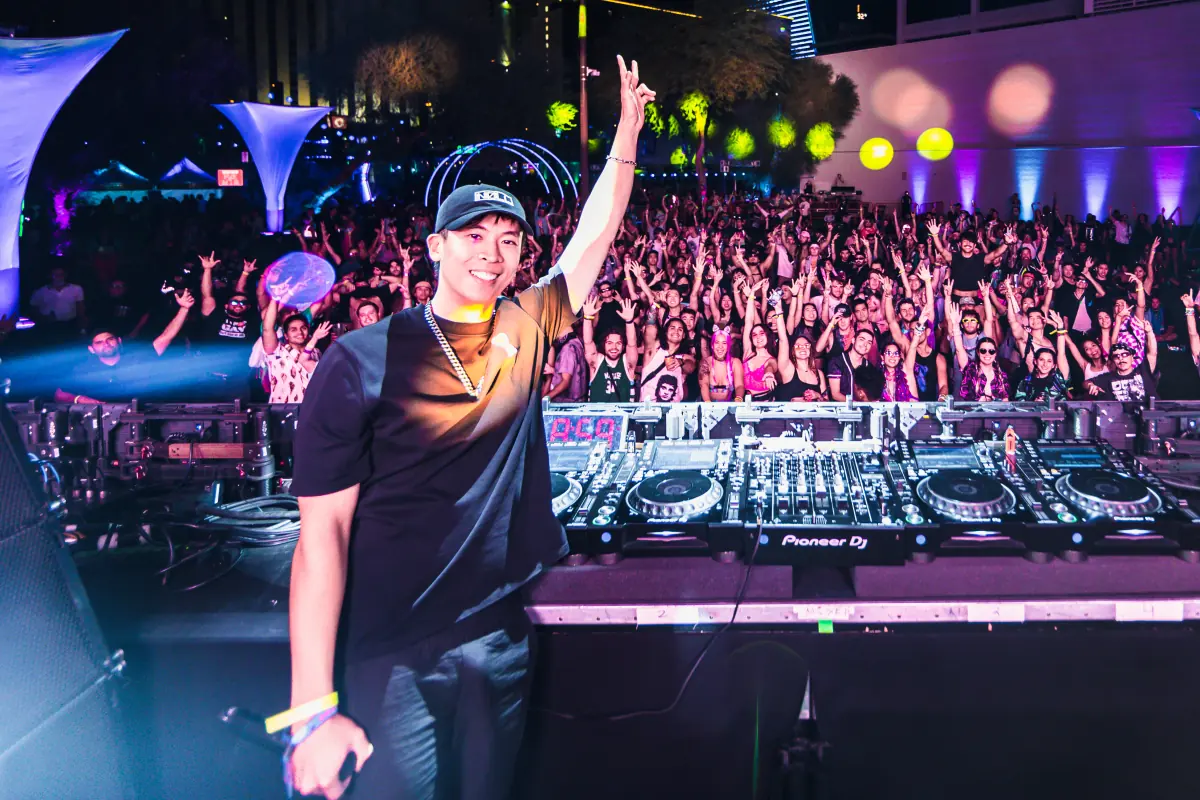
I make music as NØLL. I grew up in Texas playing violin and piano in school and district orchestras, and I've produced dance and pop records since 2016: releases on Strange Fruits, CloudKid, Lowly Palace, Lost in Dreams and NCS, and sets at Beyond Wonderland and HARD Summer.
Strings are on most of my records. The orchestral version of Safe Ground has six times the streams of the original. Writing those parts with sample libraries always felt like admin: gigabytes to load, a keyswitch on every note, and slides I had to fake.
I wanted a violinist I could hand a MIDI part to, so I built one: a physical model with a player inside, tuned against real violinists and picked by ear, Style by Style.
NØLL
Violin, Viola, Cello, Double Bass and Piano are $89 each, NØLL Strings $129.
All six together, as the NØLL Orchestral Suite, are $349.
No. A keyboard or the piano roll is enough. A sustain pedal helps, and a continuous pedal gives you half-pedaling.
Yes. It reports 64 samples of latency (1.3 ms at 48 kHz) in every setting, and your DAW lines the track up by itself.
Measured on an Apple M4 Pro at 48 kHz with a 128-sample buffer, default settings, in % of one core: a solo Violin, Viola or Cello about 1.3 %, a solo Double Bass about 1.5 %; 16 violins, violas or celli under 6 %, 8 basses about 4 %; the Piano about 1.7 % for a 10-note chord with the pedal down. NØLL Strings: about 5 % for the Quartet, 9 % for Chamber and 21 % for the Full section. A track that isn't playing sleeps at about 0.2 %.
The plugin computes the hammers, the strings and the soundboard in real time. There are no recordings inside. That is why the download is small and why every pedal and touch changes the sound.
No. Each piano is modeled from measurements of a reference instrument of its type, not recorded. NØLL is not affiliated with any maker or venue.
Download the installer, open it and follow the steps. It puts the VST3, the AU and (for the five singles) a standalone app in the usual Mac folders. Then open your DAW and load it on an instrument track. The manual shows where each DAW lists it. To move it to another computer, deactivate it first: one licence runs on 3 computers.
Any Mac DAW that loads VST3 or Audio Units: Ableton Live, Logic Pro, FL Studio, Cubase, Studio One, Bitwig Studio or Reaper. The manual has the steps for each. Every build passes Apple’s Audio Unit check and pluginval at its strictest level.
Not right now. It is Mac only (Apple silicon and Intel). Join the list to hear if that changes.
No subscription: you pay once, keep it, and every 1.x update is free. Try it first: the 14-day trial has every feature, needs no account and works offline. If you buy and it is not for you, ask for a refund within 14 days of the order.
All six: Violin, Viola, Cello, Double Bass, Piano and NØLL Strings, each complete, in one licence. There are no winds, brass or percussion in it. It is $349 instead of $574 bought one at a time, with the same terms as one instrument: pay once, a 14-day refund and every 1.x update free.